
Search Smith County Probate Court Records
Smith County Probate Court Records help connect Carthage families, heirs, and local researchers to wills, estate files, guardianship papers, and older book series that trace county life from the early 1800s forward. Smith County was created on October 26, 1799 from Sumner County, and probate matters route through Smith County Court. The best search starts with the county seat, the record series name, and the year range. That keeps you focused on the right office, the right book, and the right paper trail before you ask for copies or archive help.
Smith County Probate Court Records Office
The Smith County probate path is centered in Carthage, the county seat. The courthouse at 211 Main Street, Carthage, TN 37030 is the most direct local reference point, and the county clerk is the office that holds probate records. The register of deeds is also in Carthage at the county level, which matters when an estate touches land transfers, heirs, or a later deed trail. For most users, Smith County Probate Court Records begin with the county clerk, then move to the archives if the file is historical.
Smith County Court is the probate court named in the county research notes. That means estate work does not go to a city office in Carthage. It stays in the county system. If you are trying to sort out whether a file is active, closed, or purely historical, the courthouse address and the clerk phone number are the first details worth saving.
| County Seat | Carthage |
|---|---|
| Probate Court | Smith County Court |
| Courthouse | 211 Main Street Carthage, TN 37030 |
| County Clerk | 615-735-9833 |
| Register of Deeds | 615-735-1760 |
Note: Start with the county clerk for probate questions, then use the archives if you need older volumes, transcriptions, or historical context tied to a named series.
Search Smith County Probate Court Records
A useful Smith County search starts with the year and the record type, not just a surname. The county research notes show probate records beginning in 1805, but they also name series such as Estate Settlements, 1803-1952 and Probate Records, 1803-1956. That is not a contradiction you need to force into one answer. It is a sign that catalog labels and surviving series can cover slightly different date spans. When that happens, ask for both the general probate record and the specific book or packet series.
Smith County Probate Court Records can show up in Will Book B, Will Books, 1805-1823, Will Books, 1805-1963, Administrators' and Executor's Records, 1846-1966, Executor's Bond Book, 1860-1966, Guardian Records, 1834-1966, Inventories, 1823-1966, and Mortgage Probate Book, 1917-1930. Those titles are the best clues for a search. They tell you whether to ask for a will, a bond, an inventory, a guardian entry, or a settlement file.
If you already know the likely decade, use the series name in your request. If you only know a family name, give the clerk the year range and ask which book or packet series matches that era. That is usually faster than asking for everything tied to the surname. The broader Tennessee Probate Records guide helps explain how county will books, probate packets, and guardianship records are commonly arranged across the state.
Historical Smith County Probate Court Records
Historical work in Smith County is strong enough to support deep probate research, but it still rewards a careful order of operations. First check the Smith County FamilySearch genealogy guide. It confirms that the county clerk has probate records, that probate records begin in 1805, and that Smith County probate material survived in several named series. That guide is the quickest way to orient yourself before you write to the county or visit Carthage.
The local archival anchor is the Smith County Archives at 215 N. Main Street, Carthage, TN 37030. The archives says it maintains historical probate records, which makes it the best follow-up when you need older wills, estate settlements, or a book citation that no longer sits in active clerk use. For a county this size, that division of labor matters. The clerk handles the current county record, and the archives preserves the older trail.
TSLA also helps. The Smith County microfilm inventory is the state finding aid that can point you to preserved county reels. If you are trying to prove that a will book or estate series exists before making a trip to Carthage, that inventory is worth checking first. It can save time and narrow the search to the exact book group you need.
Smith County Probate Law
Tennessee probate law shapes the papers that show up in a county estate file. Title 30 covers administration of estates. Title 31 governs descent and distribution. Title 32 covers wills. Those three titles explain why a Smith County file may include a petition, a will, letters testamentary, letters of administration, notices to creditors, inventories, claims, and a final settlement.
For Smith County Probate Court Records, the law matters because it explains the order of the papers. The estate often opens with a filing and appointment. Then come notices, bonds, inventories, and accountings. If the person died without a will, the heirs and shares are tied to Title 31. If the family is proving a will, Title 32 matters most. If you are looking at a full probate packet, Title 30 helps you understand why the file grew in stages.
The statewide court portal at tncourts.gov gives the broader court setting that frames probate access in Tennessee. The image below uses that state portal as the fallback source because no usable local image was available for Smith County.
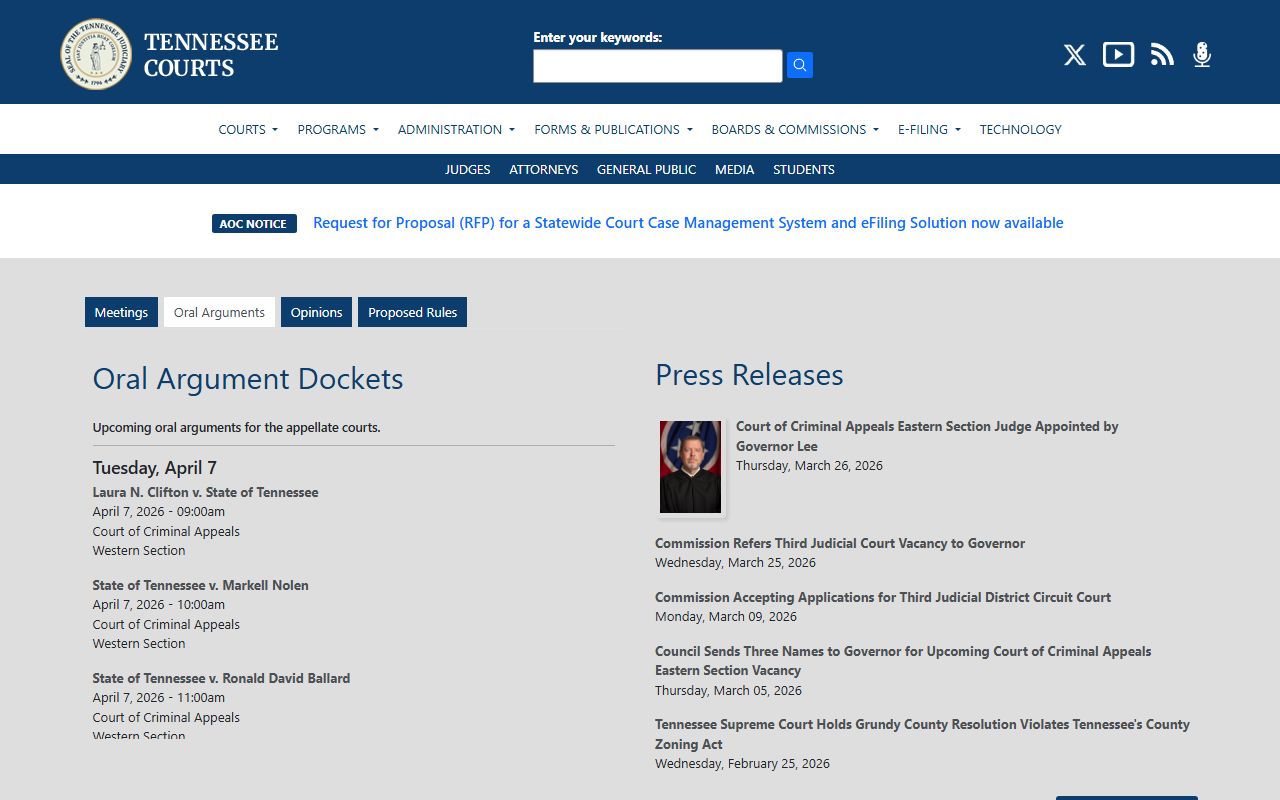
That statewide view is useful, but the file itself still comes from Smith County. The court portal tells you how Tennessee courts fit together. It does not replace the county clerk, the archives, or the original probate volume.
Note: State law explains the form of the file, but Smith County records still provide the actual facts, dates, and signatures tied to the estate.
Smith County Probate Records Series
The named Smith County series are the real map for this county. Smith County Miscellaneous Wills can catch items that do not fit neatly into a single will book. Will Book B is a useful early marker when a search reaches back into the county's first probate decades. Will Books, 1805-1823 and Will Books, 1805-1963 show that the county kept a long run of bound will material, so a request can often be narrowed to a specific book span instead of a broad estate search.
Other series fill out the estate story. Administrators' and Executor's Records, 1846-1966 can show who was appointed to settle an estate. Estate Settlements, 1803-1952 and Estate Records, 1865-1947 can show how the property was divided or closed. Executor's Bond Book, 1860-1966 and Guardian Records, 1834-1966 are especially useful when a family member was placed in charge of an estate or a minor's property. Inventories, 1823-1966 and Mortgage Probate Book, 1917-1930 add more detail when the estate touched land, debt, or later bookkeeping.
When you know the series name, the request becomes easier to route. Carthage staff can check the clerk file, the bound book, or the archival copy faster when you ask for the exact probate series rather than a surname search alone. That is the main advantage of knowing Smith County Probate Court Records by title.
Get Smith County Probate Court Records
For copies, begin with the county clerk if you need a current or recently handled probate matter. If you need older material, move next to the Smith County Archives in Carthage. The best request includes the decedent's full name, the approximate year, and the record series. That lets staff check the right book, packet, or clerk file without guessing which Smith County Probate Court Records you mean.
Keep the request narrow. Ask for a will book entry, an estate settlement, an administrator's record, a bond book, or a guardian record if you know which one you need. If you are not sure, ask for the surviving probate series for the year range you have. That approach works better than asking for "everything" on one family. It also respects the way Smith County kept its probate record set.
The county archive at 215 N. Main Street and the courthouse at 211 Main Street are close enough to make Carthage the natural research base for the county. If your search has stalled, a call to the clerk can confirm whether the file is still active, already indexed, or better handled by the archives. That small check can save a lot of time.
Cities in Smith County
Smith County Probate Court Records serve the whole county, but the county seat remains the key probate access point. If you want another Tennessee city page for comparison, use the statewide city directory below.
Nearby County Searches
Smith County borders other Tennessee counties that can matter when an estate was filed near a county line, involved land in more than one county, or belongs in a neighboring probate venue instead. Use these adjoining county pages when the record trail moves outside Smith County.