
Search Shelby County Probate Court Records
Shelby County Probate Court Records help people trace estates, review wills, confirm guardianship filings, and request certified court papers in Memphis, the county seat. This county has one of Tennessee's few separate probate courts, so the search process is more direct than in counties where probate is folded into another clerk's office. Start with the online portals for recent case data, then use the clerk counter for older files, document copies, or questions about a probate matter that needs staff review.
Shelby County Quick Facts
Shelby County Probate Court Records
Shelby County was created in 1819 from Indian lands and Fayette County, and its probate work is handled by a separate court rather than a general county clerk. That matters when you search Shelby County Probate Court Records because the court in Memphis maintains a focused docket for estates, wills, guardianships, conservatorships, name changes, corrections to birth certificates, and judicial hospitalization matters handled under state mental health law. The clerk's public counter is at 140 Adams Avenue, Room 124, Memphis, TN 38103. General help is available through probatehelp@shelbycountytn.gov or by phone at (901) 222-3750, while copy requests go to probate.copies@shelbycountytn.gov. Office hours listed for public access are 8:00 a.m. to 4:30 p.m. on business days.
The official Shelby County Probate Court page outlines the court's location, contact channels, and case types for people who need to file or obtain records.
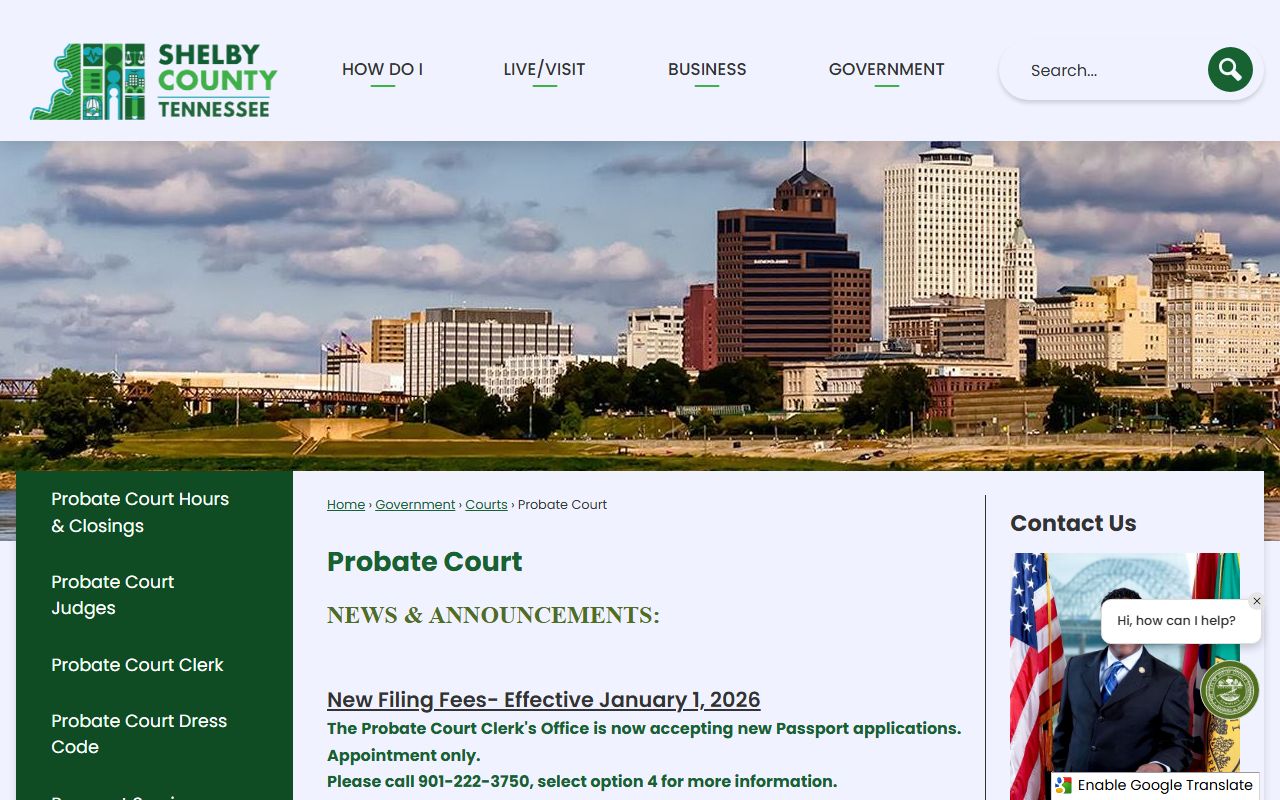
Use that office page first when you need current filing guidance, clerk contact details, or confirmation that your request belongs with the Shelby probate court rather than another Memphis court office.
| Court | Shelby County Probate Court |
|---|---|
| Address | 140 Adams Avenue, Room 124 Memphis, TN 38103 |
| Phone | (901) 222-3750 |
| Hours | Monday through Friday, 8:00 AM to 4:30 PM |
| Copies | probate.copies@shelbycountytn.gov |
Search Shelby County Probate Court Records
Recent Shelby County Probate Court Records can be searched online, but the county splits access by filing date. The court's e-services page explains that searchable probate records run from 1997 to the present, while document images are generally available from 2012 forward. Cases filed before October 2013 use the older PW1 case information system, and later cases use the current case information tools tied to the Shelby probate court search pages. The main public search guidance appears on the Shelby probate e-services and records search page. For the older case information portal, use the Shelby probate data search to look up party names or case numbers. The court says RCAS data updates every 24 hours, and newly filed document images may take up to 72 hours to appear. If the online display and the courthouse file do not match, the courthouse record controls.
The probate data portal gives a direct view of the older search interface used for pre-October 2013 probate matters in Shelby County.
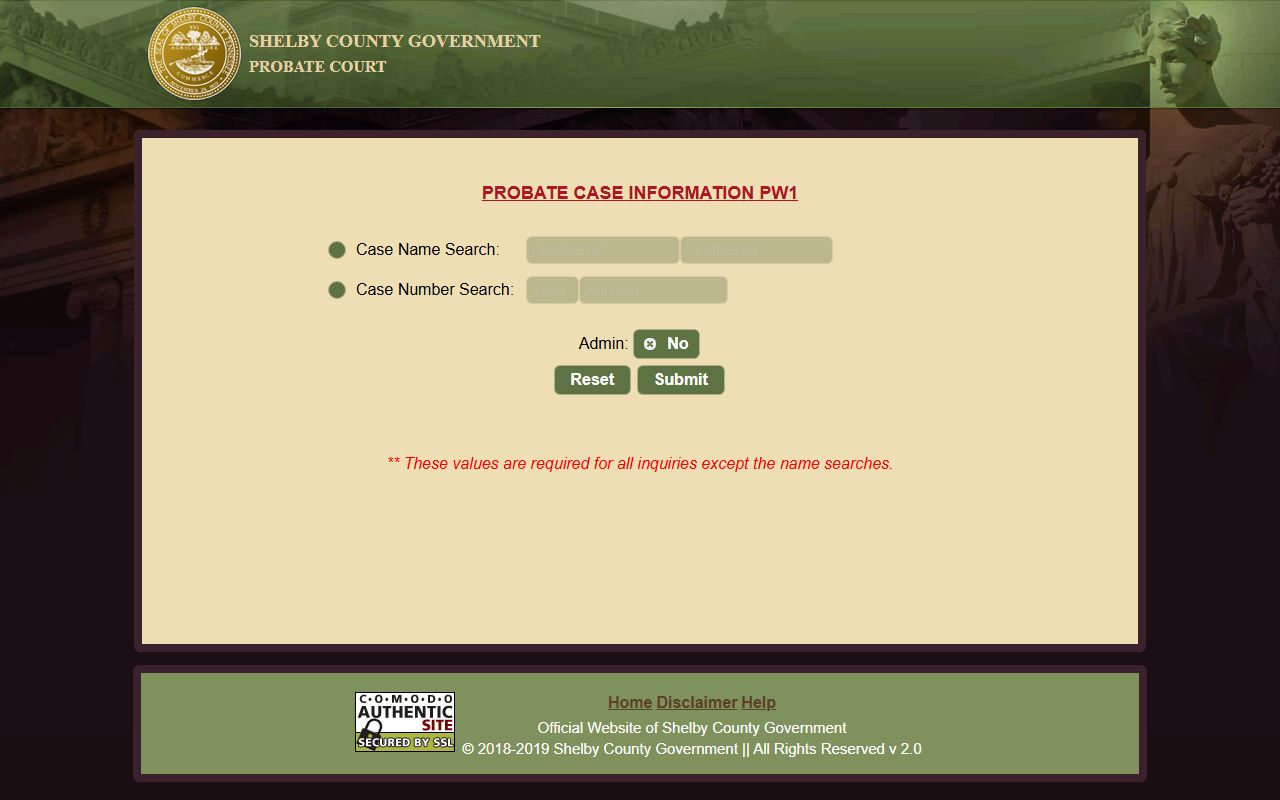
That portal is useful when you already know a party name or docket number and want to confirm whether a Shelby estate or guardianship case is in the separate probate system. Before you search, gather the details most likely to narrow the result list:
- Decedent, ward, or protected person's full name
- Approximate filing year or date of death
- Case number or docket number if known
- Whether the matter is an estate, guardianship, conservatorship, or another probate filing
Pre-2012 Shelby County Probate Court Records usually require an in-person visit because the court says older documents remain on microfiche or microfilm at the clerk's office. The same e-services area also provides access to the court calendar after the user accepts the disclaimer and completes the site checks. Not every hearing or judge appears online, so call the clerk if the setting matters. Note: Online search is best for case tracking, but the clerk's file remains the official source when timing, image availability, or docket wording matters.
Shelby County Probate Court Records Access
Public access to Shelby County Probate Court Records is shaped by Tennessee Supreme Court Rule 34 and the Tennessee Public Records Act. A local Shelby probate records guide at shelbycountycourt.us/probate-records explains that public files may include wills, probate petitions, estate inventories, estate accountings, guardianship records, and conservatorship records, while sealed and exempt information stays protected. That distinction matters because probate files often mix open court papers with medical, financial, or personal data that cannot be released in full.
In practical terms, most people can inspect public Shelby County Probate Court Records in person at 140 Adams Avenue during regular business hours, then ask for copies or certification if needed. The court also provides copy service through the probate copies email address listed by the official county page. The safest way to make a request is to include party names, a case number if you have one, and the specific document you want, such as letters testamentary, an order admitting a will, an inventory, or a final accounting.
Common record types available in the public file can include:
- Wills and codicils filed for probate
- Petitions to open an estate or appoint a personal representative
- Estate inventories and accountings
- Guardianship and conservatorship pleadings
- Name change orders and related petitions
- Orders entered by the probate judge
When you need plain or certified copies, ask the clerk to confirm what can be reproduced from the public file and whether older microfilm material needs extra retrieval time. Shelby County Probate Court Records can include sensitive proceedings, especially when mental health or protected-person issues are involved, so some papers may be limited even when the case itself is visible on the docket.
Historic Shelby County Probate Court Records
Historic Shelby County Probate Court Records go far beyond the current online portals. The FamilySearch Shelby County probate historical records page points researchers to probate case files and journals from 1828 to 1930, wills from 1830 to 2004, minutes from 1824 to 1829 and 1867 to 1898, and will books from 1830 to 1862. Those ranges help explain why a modern case search may stop short while older probate content survives in separate historical series.
For statewide context, the FamilySearch Tennessee probate guide explains how Tennessee probate materials are arranged by county and record type, and it notes that separate probate courts exist only in a few counties, including Shelby. The Tennessee State Library and Archives is the main state repository for microfilmed probate materials, so it becomes especially useful when you need a record that predates the court's online image coverage or when you want to compare Shelby files to broader Tennessee holdings.
Subscription databases can help too. The Tennessee wills and probate collection at Ancestry includes indexed probate material from many counties and can be a good finding aid before you order copies. Still, Shelby County Probate Court Records should be verified against the courthouse file or state archive copy when you need something for legal use, because derivative databases are research tools rather than the controlling record.
Note: Historical probate research often means moving between Memphis clerk files, FamilySearch images, and TSLA microfilm rather than relying on one database alone.
Shelby County Probate Court Laws
Shelby County Probate Court Records reflect Tennessee probate law first and local filing practice second. The court structure and statewide forms are tied back to the Tennessee Courts portal, while estate administration rules sit in Title 30 of the Tennessee Code. When a Shelby estate is opened, the filings you see in the docket are shaped by Title 30, intestate succession rules in Title 31, and will execution and revocation rules in Title 32.
That legal framework shows up in the file. Tenn. Code Ann. §§ 30-2-301 and 30-2-302 are part of the estate administration sequence that leads to inventories and related record entries appearing in the court file. Tenn. Code Ann. § 30-2-306 governs notice to creditors, and § 30-2-307 sets the claims period that often becomes a key date in Shelby County Probate Court Records. When you review a docket, those statutes explain why creditor notice, proof of publication, claims, and final settlement papers appear when they do.
For users who are not lawyers, the main point is simple. The probate record is not just a list of forms. It is a timeline of required steps. If a will controls distribution, Title 32 matters. If there is no will, Title 31 shapes who inherits. If the estate needs administration, Title 30 governs the filings you are likely to request from the Shelby clerk.
Note: Statutes explain why a record exists, but the docket date, signed order, and stamped filing in Memphis remain the operative proof.
Memphis and Shelby County Records
Memphis is the county seat, so every in-person search for Shelby County Probate Court Records leads back to the same downtown courthouse location on Adams Avenue. That county focus is important. Probate cases are not divided by neighborhood or municipal boundary inside Shelby County. If the decedent lived in Germantown, Bartlett, Collierville, or Memphis, the records route is still the Shelby County Probate Court in Memphis unless venue belongs elsewhere under Tennessee law.
Memphis also matters for practical reasons. The clerk counter is where older microfiche and microfilm access happens, where certified copies are issued, and where the official record resolves any mismatch with what appears online. People often start with the online search tools, then shift to Memphis for full file review, certified copies, or older will books that are not posted as current web images.
This is also why county-level probate research and city-level local history overlap in Shelby. Memphis serves as the access point, but the substance of the file remains county probate work tied to estates, heirs, wards, conservatees, and court supervision of property or care decisions.
Shelby County Probate Court Requests
A strong request for Shelby County Probate Court Records is specific. If you email or visit the clerk, identify the case as clearly as possible and say what you need from the file. Broad requests slow the process, especially when the matter is older than the online image system or when the clerk must confirm that a document is public before copying it.
Ask for the exact item if you can: the will, letters testamentary, order admitting the will to probate, inventory, accounting, guardianship petition, conservatorship order, or certified final order. If you only need proof that a case exists, the online docket may be enough. If you need a record for a bank, title issue, estate dispute, or family research file, it is better to request the precise Shelby County Probate Court Records document from the clerk.
Keep in mind that recently filed images may not appear right away, and older files may live on microfilm. That is normal for this court. Shelby's system is useful, but it works best when you treat the website as a locator and the clerk's office as the final source for copies and certification.
Cities in Shelby County
Shelby County Probate Court Records still route through the county seat and county probate system, but these city pages give you location-specific context for residents who begin the search from different communities inside the county.
Use these city pages when you want local access notes that still point back to Shelby County probate records.
Nearby County Searches
Shelby County borders other Tennessee counties that can matter when an estate was filed near a county line, involved land in more than one county, or belongs in a neighboring probate venue instead. Use these adjoining county pages when the record trail moves outside Shelby County.