
Search Greene County Probate Court Records
Greene County Probate Court Records are easiest to search when you start in Greeneville and work from a specific record type. If you need a will, estate settlement, inventory, bond, or older county court entry, the county seat gives you the right point of entry for both active requests and historical research. Greene County has a long probate history, but the earliest years are uneven, so a focused search matters. Start with the decedent name, an estimated date, and the record series you expect to find, then move outward only if the first Greeneville request does not return the exact estate paper you need.
Greene County Probate Court Records Quick Facts
Greene County Probate Court Records Office
The Greene County FamilySearch guide says Greene County was created in 1783 from Washington County, North Carolina, and it identifies the county clerk as the key custodian for marriage and probate records from 1783. That is the first thing to understand about Greene County Probate Court Records. The county seat is Greeneville, and the courthouse system there is where a probate search starts when you want the official county trail rather than a broad statewide index.
The same local research notes also warn that many pre-1800 marriage bonds were lost and that probate records from 1783 to 1800 are missing. That gap matters because it changes how an early family search should be built. If your estate falls in those first years, the county may still have related court references, land clues, or later family references, but the probate paper trail itself may be thin. For most requests, the safer path is to search Greene County Probate Court Records by year range and record series, then follow whatever surviving book or index entry turns up in Greeneville.
| County Seat | Greeneville |
|---|---|
| Probate Court | Greene County Court |
| County Clerk Phone | (423) 798-1778 |
| Record Coverage Note | County Clerk summary lists probate records from 1783, but probate records from 1783 to 1800 are noted as lost |
That office context is useful even before you know whether the estate lives in a will book, a settlement volume, or a county court entry. When the record type is clear, the Greeneville office can be much more precise about where the surviving volume or file belongs.
Search Greene County Probate Court Records
A narrow request is the best way to search Greene County Probate Court Records. Probate is not one single file. In Greene County, the estate trail can include wills, bonds and letters, inventories, settlements, accounts of insolvent estates, or miscellaneous county court entries that capture part of the administration. If you ask only for a surname, the search can drift. If you ask for one record type and one date range, the county office or archive source has a better chance of landing on the right book immediately.
For online lead work, the Tennessee public court records portal is worth checking because it includes Greene County Circuit Court and General Sessions online access. That portal does not replace the probate books, but it can help you confirm related court activity and understand how Greene County court records are organized. If you already have a family clue from a deed, newspaper notice, or cemetery entry, use that clue to estimate the year before you ask for Greene County Probate Court Records.
Useful details to gather before you request Greene County Probate Court Records include:
- The decedent's full name and any alternate spelling
- An estimated death year or probate filing range
- The record type, such as a will, inventory, bond, settlement, or insolvent estate file
- Any book, page, volume, or index clue already found
- A note confirming the estate belongs in Greene County rather than a nearby county
FamilySearch's Tennessee probate guide is also helpful here because it explains how Tennessee probate material is often arranged by county and then by date. That format is exactly why Greene County searches work better when you move from a broad family-name hunt to a specific book or file request.
Note: If the estate date falls in the lost 1783 to 1800 gap, a clean county probate result may not exist even though the family clearly lived in Greene County.
Greene County Probate Court Records History
Greene County probate history starts with the county itself. Since Greene was created in 1783 from Washington County, North Carolina, the earliest records sit close to the period when Tennessee was still part of North Carolina. That is why Greene County Probate Court Records can be very old, yet still uneven in the earliest decades. The county did keep a long probate tradition, but the surviving record series are strongest from the early nineteenth century forward.
The most useful Greene County probate series are easy to identify once you know the names. The research points to Will Books, 1802-1843, Wills, 1828-1854 and 1828-1931, Settlements in Estates of Deceased Persons, 1802-1933, Inventories of Estates, 1828-1920, Bonds and Letters of Administrators, Executors and Guardians, 1882-1951, Accounts of Insolvent Estates, 1853-1901, and Miscellaneous County Court Records, 1851-1915. Those runs show that Greene County Probate Court Records are spread across several record types, not just a single will book.
That variety matters because one estate may leave a will, while another leaves only appointment papers, inventories, settlements, or a court order in a miscellaneous volume. A surname search alone can miss those differences. If you know the decedent was probably intestate, the settlement and bond series may be more useful than the will books. If the estate was insolvent, the insolvent estate accounts may tell you more than a final distribution entry.
The key historical takeaway is simple. Greene County Probate Court Records are rich, but they are layered. The later books often point back to earlier families, while the early gaps mean that one record series may survive where another does not. That is normal for Tennessee county probate research, and it is especially important in a county with record loss in the first decades.
Greene County Probate Court Records Online
The best online work for Greene County Probate Court Records usually starts with a finding aid, not with a complete estate packet. TSLA remains one of the best guides for older county record series because it preserves microfilm references and helps researchers understand what may survive outside the courthouse. The Tennessee State Library and Archives is especially useful when you need to confirm whether a Greene County book or roll has been microfilmed before you ask for a copy in Greeneville.
The Tennessee courts portal adds statewide court context and is the source for the state-level image below. It is not a substitute for the county probate books, but it is a reliable starting point when you need to orient a request inside the Tennessee court system before turning back to Greene County Probate Court Records.
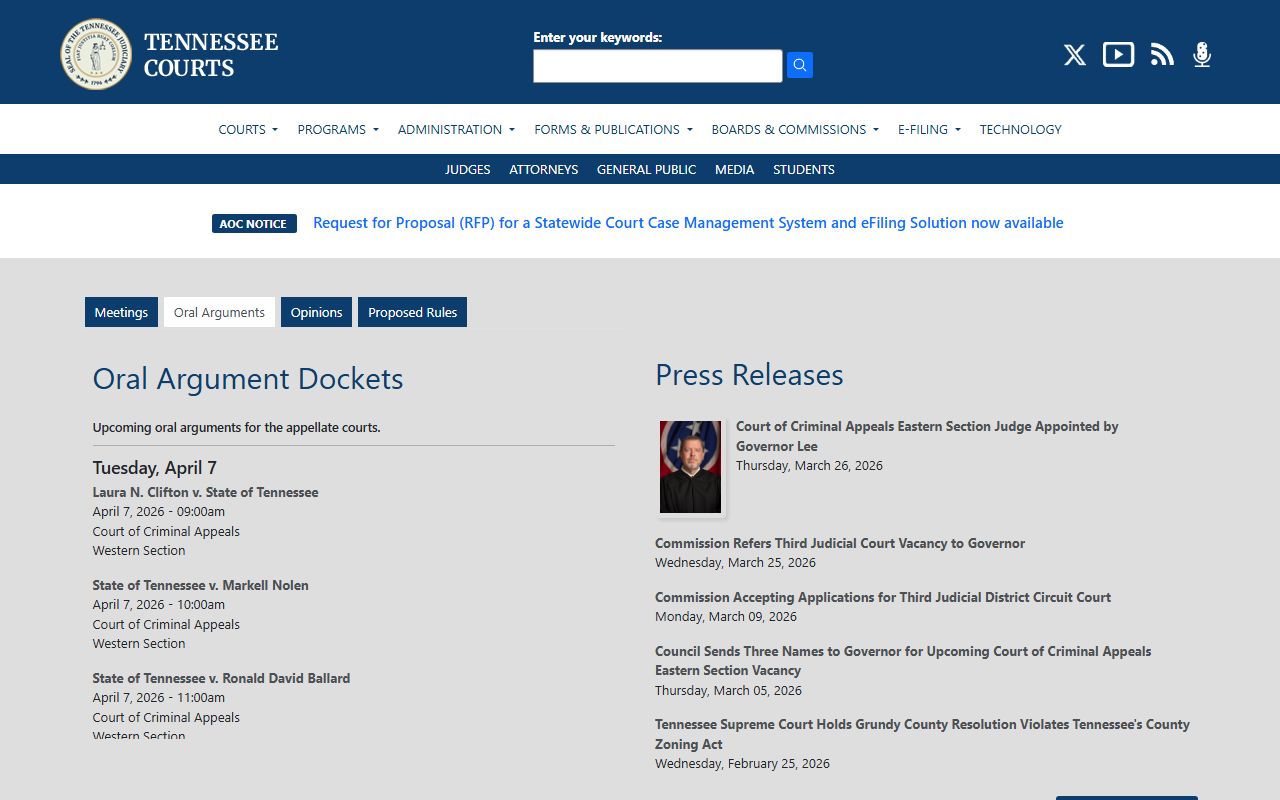
That state portal helps show the broader court framework, while the Greene County probate file itself still provides the estate detail that matters for a local search.
Online tools are most effective when you treat them as a map. They can point you to a county, a year, or a record series, but the actual answer still lives in the Greeneville record set. If you have already identified a will book or settlement volume, online access can save time by telling you which file or microfilm lead to follow next.
Greene County Probate Court Records Law
Greene County Probate Court Records are shaped by Tennessee probate law, which explains why estate files often contain more than one type of paper. Title 30 covers administration of estates. Title 31 covers descent and distribution when there is no valid will. Title 32 covers wills and probate procedure. Together, those titles explain why a Greene County estate may create a will entry, a bond, notices to creditors, inventory paperwork, and a settlement record instead of just one document.
The details of administration matter because they shape the record trail. Tenn. Code Ann. sections 30-2-306 and 30-2-307 help explain why probate files often include notice to creditors and claims handling. Even when you are not studying the statute itself, knowing that framework helps you understand why Greene County Probate Court Records can include publication proof, claims, objections, or accountings that look separate at first but are actually part of one administration.
That legal context also helps when you are comparing records across counties. A Greene County will book may look different from a settlement volume in another Tennessee county, but the underlying estate process follows the same statewide structure. The law does not replace the local record. It simply tells you why the local record was created in the first place.
Greene County Wills And Bonds
The strongest Greene County Probate Court Records often come from the series that sit around the will itself. Wills, bonds and letters, inventories, and settlements are the core materials that tell you who handled the estate, what property was listed, and how the administration was closed. If a will is missing, the other record types may still confirm the heirs, the administrator, or the date range you need for further research.
Greene County is especially useful because its probate series are spread across long ranges. The will books run from 1802 to 1843, while the separate wills coverage extends from 1828 to 1854 and again from 1828 to 1931. Inventories reach from 1828 to 1920, settlements in estates of deceased persons run from 1802 to 1933, and bonds and letters of administrators, executors, and guardians extend from 1882 to 1951. Those series show that Greene County Probate Court Records can support both early family reconstruction and later estate verification.
When you request a copy, it helps to name the exact record series instead of asking for everything connected to a surname. Common Greene County record types include:
- Will books and separate wills
- Bonds and letters for administrators, executors, and guardians
- Inventories of estates
- Settlements in estates of deceased persons
- Accounts of insolvent estates
- Miscellaneous county court records that may capture stray probate references
That series-based approach is often the difference between a partial family clue and a complete estate trail. It is also the best way to search Greene County Probate Court Records when the file was recorded in more than one book or when later settlements point back to an earlier appointment.
Greeneville Probate Routing
Greeneville is the county seat, so it remains the practical starting point for Greene County Probate Court Records even when the family story begins in a smaller community elsewhere in the county. The city name helps identify where the person lived, but the probate venue is county based. If the estate was opened in Greene County, Greeneville is where the record request should begin.
The county clerk phone number, (423) 798-1778, is the most direct local contact in the research notes. If you already know the approximate year and record type, that office can help you narrow the search much faster than a broad county-wide request. When the first search does not find what you want, try a different probate series before assuming the record is gone. In Greene County, a will, settlement, or miscellaneous court entry can survive even if another related item is missing.
Cities in Greene County
Greene County Probate Court Records serve the whole county, but the county seat remains the key probate access point. If you want another Tennessee city page for comparison, use the statewide city directory below.
Nearby County Searches
Greene County borders other Tennessee counties that can matter when an estate was filed near a county line, involved land in more than one county, or belongs in a neighboring probate venue instead. Use these adjoining county pages when the record trail moves outside Greene County.